
Reflections on COP30 in Belém: Infrastructure, Innovation, and Action
Having just returned home from COP30 in Belém, Brazil, I am left with a strong sense of both urgency and momentum around the future of sustainable infrastructure. Holding this year’s climate conference in the heart of the Amazon region brought a powerful sense of realism to the discussions. The vulnerability of ecosystems, the scale of development needs, and the pressure to deliver real solutions were present in every conversation.
Across the week, infrastructure emerged as a central pillar of the climate transition. Energy systems, transport networks, resilient cities, water, and digital infrastructure were not discussed as isolated sectors, but as interconnected foundations of inclusive and low carbon development. What stood out most was the convergence between climate ambition and investment practicality. There is growing alignment that sustainable infrastructure must be not only climate aligned, but also bankable, scalable, and credible in the eyes of global investors.
It was a privilege to lead a panel hosted by the International Development Finance Club that captured this shift extremely well. The discussion brought together public development banks, institutional investors, digital innovators, and sustainability standards experts to explore how sustainability standards and technology can work together to de risk investment, enhance transparency, and mobilise capital at scale. Despite the inevitable logistical challenges that come with gatherings of this size, the exchange was focused, concrete, and deeply relevant to today’s market realities.
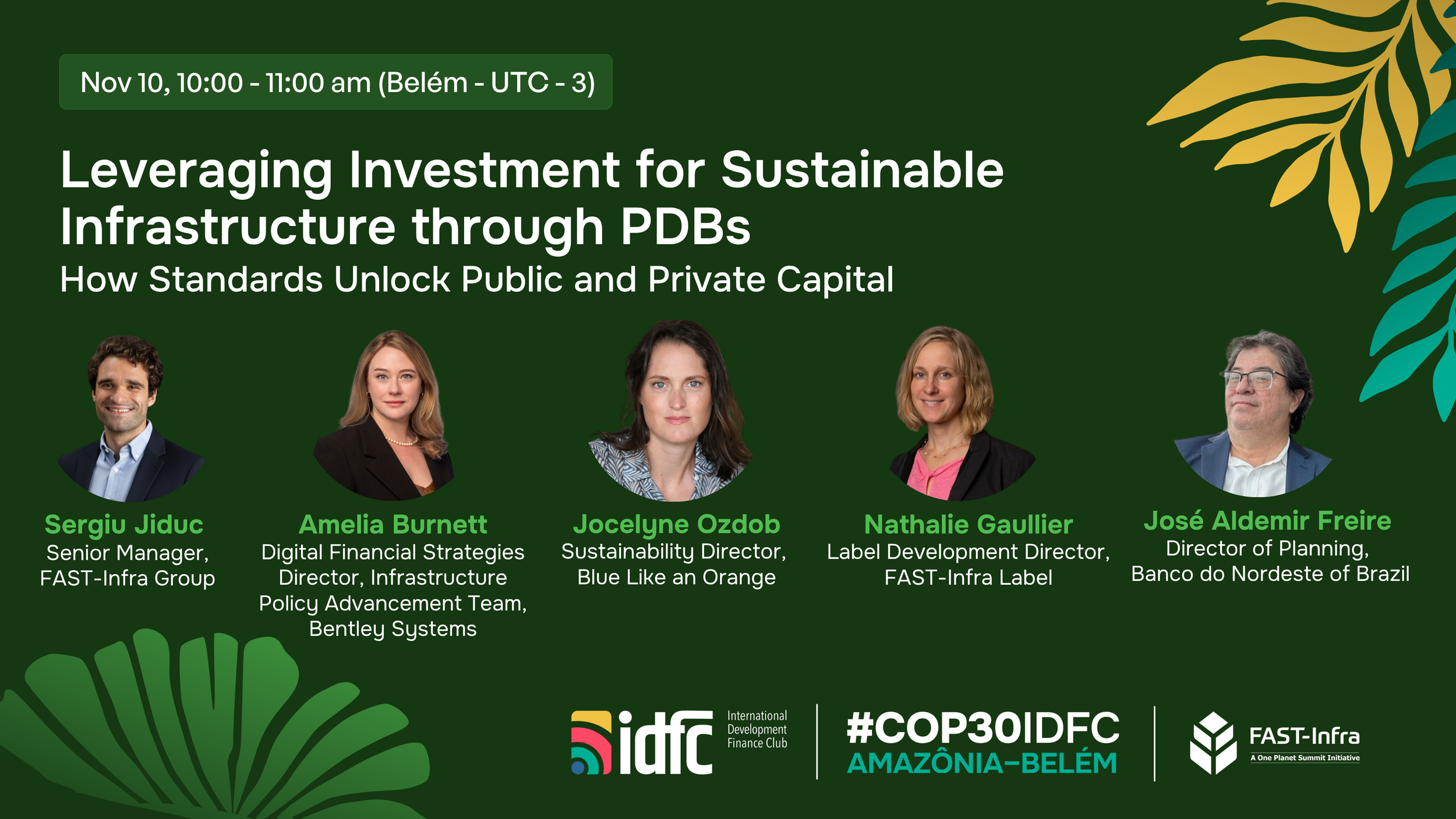
A key message from the panel was clear. Common sustainability frameworks such as the FAST Infra Label play a crucial role in defining what sustainable infrastructure actually means in practice. They provide shared benchmarks, comparability, and confidence for investors and public institutions alike. Digital tools and software solutions then make these standards operational. By embedding sustainability criteria into project assessment, due diligence, and ongoing monitoring, technology transforms principles into actionable, investor-friendly processes.
Throughout COP30, this same logic echoed across many infrastructure and finance discussions. Standards build trust. Digitalisation drives efficiency and transparency. And when both are aligned, they create the conditions needed to channel capital more effectively toward projects that deliver real climate and development impact.
Beyond the technical debates, Belém itself left a lasting impression. The intensity of the tropical climate, the sudden downpours, and the visible proximity to the Amazon rainforest were constant reminders of what is at stake. These are not abstract policy questions. They touch directly on livelihoods, ecosystems, and long-term economic resilience.
I am deeply grateful to the International Development Finance Club for hosting our session and to all the panellists who shared their insights with such openness and pragmatism. COP30 reaffirmed that the transition to sustainable infrastructure is no longer about vision alone. The tools, standards, and partnerships now exist. The task ahead is to deploy them at the scale and speed that the moment demands.