

Yukshin Gardan Sar
- Karakoram, Pakistan -
…The rope is fully tensed. Matthew must have fallen into another crevasse. I hold my belay system diligently and kneel down in the soft, fresh snow to better control the forces that are pulling me across the edge into a deep abyss. All around us, the blizzard has completely engulfed the giant, jagged peaks of Shimshal Valley, many of them over 7500m high. Visibility has been reduced to less than 20 meters. I feel so weak that I can barely manoeuvre the rope to rescue Matthew out of the ice tomb. The last 2 days have been particularly hard, as we had no chance to make water and prepare it. If it wasn’t for the towering seracs marking the crevasse edges, we would have been long dead. Where are we, you may ask? It must be hell…


Figure 1. Map showing attempted route up the Southeast Face from Yukshin Glacier. ©Google Earth, 2020
The Climb
In the summer of 2015, as part of a multidisciplinary project called the Karakoram Anomaly Project, Mathew Farrell and Sergiu Jiduc attempted to climb a remote, poorly explored 7000m+ peak in the Hispar–Muztagh Group, a subrange of Pakistan's mighty Karakoram Range. Known as Yukshin Gardan Sar, the mountain measures 7530m above sea level and lies about 15 km northeast of Khunyang Chhish (7852m) and 5 km northwest of Kanjut Sar (7760m), - two other giants of this planet, barely missing the membership of the 8000m+ club. Yukshin Gardan Sar is flanked to the northwest by the Yazghil Glacier and to the northeast by the Yukshin Gardan Glacier, both of which drain into the notorious Shimshal River.

Figure 2. North Face of Yukshin Gardan Sar (7530 m) as seen from Base Camp (3700 m). ©Matthew Farrell, 2015
Yukshin Garden Sar is a technically difficult mountain that has not been climbed since 1986. With only three small teams attempting the mountain, it is fair to say the peak is poorly documented in the literature. In fact, most peaks of the Shimshal Valley have neither been climbed nor properly described. The route via the south face of Yukshin Gardan Sar that we attempted had never been climbed before and no information whatsoever was available about this face. Therefore, our risk assessment was primarily based on Google Earth Maps and on-site observations. It is worth mentioning that the sense of perspective in the Karakoram can change dramatically – the sheer size of glacier features here is enormous and beyond anything we have ever seen.
Having already established a base camp on the western lateral moraine of Yukshin glacier, the next important leg of the mountaineering quest was to set up an advanced base camp (ABC) from which we could attempt several ascents up the extremely fragmented ice fall that was separating us from the col. The terrain was complex, riddled with hanging seracs and menacing crevasses, and so remote that any hope of help was impossible. No wonder no one has ever tried to climb this route.

Figure 3. Matt standing on one of the many seracs in Yukshin's Ice Fall. ©Sergiu Jiduc, 2015
In addition to the objective hazards posed by the glacier, changing, unpredictable weather and extreme cold were not on our side, especially in the high camps. Every big mountain constructs its own microclimate, which can be very unpredictable. As a result, weather forecasts for big, remote mountains are only 50% accurate, making decision-making difficult. Experience, on-site observations, and intuition play a major role in deciding whether to push forward or abandon a climb. We tried twice to reach the summit from Camp 3 at 6400m. However, our contingency time ran out, and so did our supplies. Two failed summit attempts, due to the extreme cold (-35ᵒC) and high avalanche risk, resulted in overconsuming our supplies. We decided to get off the mountain as soon as possible. On day 10 on the mountain, we were at Camp 2 (5800m), and we realised our gas was used up. This marked the moment when our situation became very problematic.

Figure 4. The Upper sections of Yukshin Gardan Glacier. ©Sergiu Jiduc, 2015
In addition, the mountain was all around us, strongly asserting its presence, with frequent rock and ice avalanches blasting from the rupture of hanging ice seracs and running down the south face, barely missing us. To make matters worse, the blizzard, which started during our summit attempts, was omnipresent. Not having enough gas to melt snow to make water and cook food was a huge problem, especially since we were a long way from safety (2000m level difference, to be precise). In addition, we were experiencing whiteout conditions and feeling exhausted and lost. The survival mission back to the advanced base camp took us 3 days and involved no water or food whatsoever, falling into dozens of crevasses, and dragging ourselves through fresh, deep snow on possibly the worst glacier we have ever been on in our lives.
We even tried to call for a rescue helicopter from the military, but these issues take time, a commodity we could not afford at that time. In the end, our strong motivation, good teamwork, and luck pushed us to safety. We descended safely to ABC without a helicopter rescue. This was due to an inspired decision to cross the icefall laterally and enter the north face of the mountain, where we found water and abseiled in a steep and gigantic gully using some 40+ rappels.
“He who climbs upon the highest mountains laughs at all tragedies, real or imaginary.”
— Friedrich Nietzsche


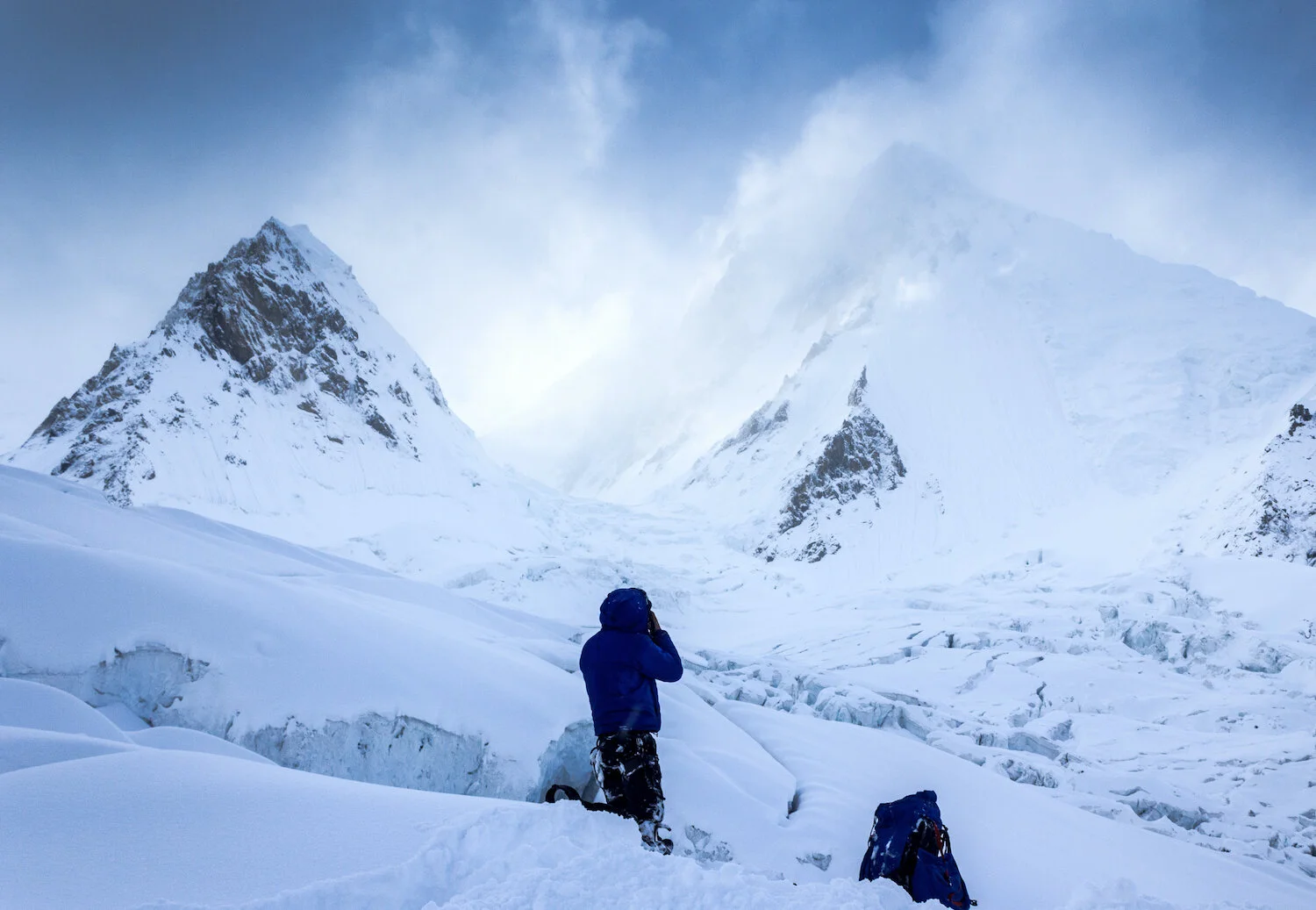


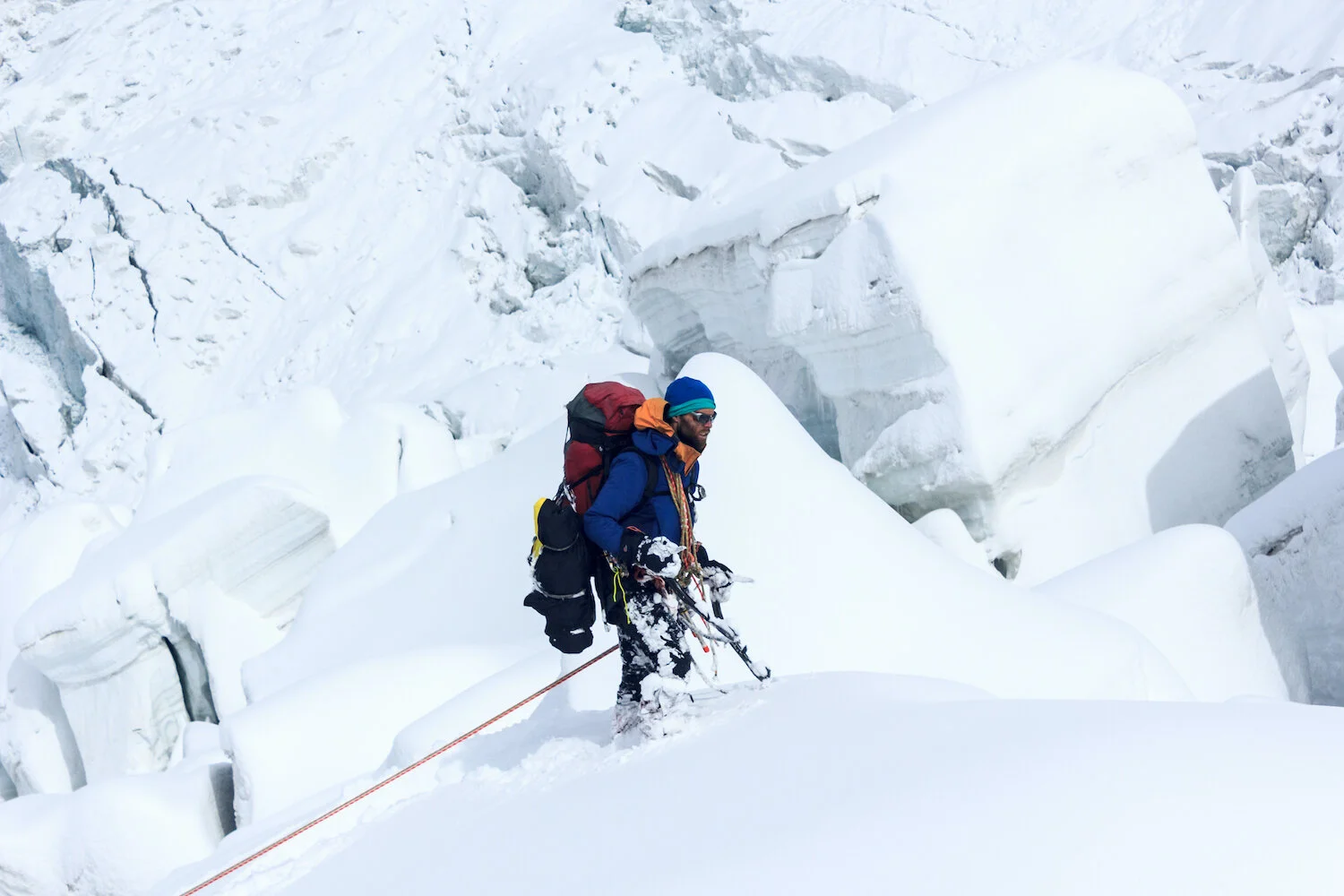
Fatigue is a moment of surrender. We are more aware of our surroundings; we feel rather than think, and this leads to our first discovery: an icy couloir carved into the vast limestone north face of the mountain. Inside this gully, a voluptuous world made of calcium carbonate and hundreds of millions of years-old little fossils. Long and sinuous, the gully has holes in its fabric and is covered in white snow and blue ice. In its details, we see beauty born of consequence. Everyone should be so lucky to witness such grace.
Why did we attempt this mountain? Nobody has been on it since 1986, when a Spanish team comprising Alejandro Arranz, Iñaki Aldaya, Alfredo Zabalza, and Tomás Miguel climbed it via the southwest ridge. In fact, only three teams have ever attempted this mountain, and no human being has ever set foot on the southeast face. A world first on this face sounded like an interesting mission.
However, Yukshin is an aesthetically beautiful mountain! A rock and ice pyramid, almost perfectly symmetrical, towering more than three and a half kilometres above the Yukshin Glacier, it cuts the sky like Poseidon’s trident. Climbing this majestic peak would have been a great honour. We also appreciated that the mountain lies in the valley where we were conducting our scientific research, so attempting to climb it meant easier logistics, as we could avoid moving our camp to another valley.
Our real lives are a night sky, full of constellations. Everything we anticipated is only half of what happened; remote is a definition, not an emotion. Connecting to the endless is possible; out in the dark and in the wild, we allow it. Packed up, listening for an engine, it was a lifetime ago that we were friends. Now we are a family whose only purpose is to keep moving. If we could, we would stay out here, forever. This is our real life. This is where we belong.
Lewin’s equation described human behaviour as a function of personality plus environment. It was the first theory of human nature to value a person’s momentary situation, rather than relying entirely on the past. As humans, we have all encountered turning points, moments of decision-making that will affect the course of our lives, whether we recognise it in the moment or not. To be steadfast is to have known the weakest part of yourself and moved through that territory into an unwavering commitment. No one here is rough or raw. They are unshakable, tightly bound, like industrial cable that will not fray, meeting whatever happens with muscle and guts, humility and grit.
Read the full story in the Outdoor Journal!
My quest for beautiful lines up mountains where I find peace and clarity through intense mental focus where I can tune everything else out and just focus on that next step will continue. Risks are always calculated but there are moments when it just doesn’t feel right. Having a passion can be both a great uplifting thing and a curse.

Figure 5. Yukshin Gardan at dusk. ©Ana Pavalache, 2018